


Pendant Lighting Choices to Elevate Your Dining Room Ambiance
There’s something special about a South African dining room at night – the kids’ homework cleared off the table, a potjie or roast resting, and everyone gathering under a warm pool of light. That “pool of light” is usually your pendant, and when you get it right, the whole room feels more welcoming, flattering, and effortlessly stylish.
At Future Light, we’ve helped thousands of South African households – from compact Cape Town apartments to big family homes in Pretoria and Durban – transform their dining spaces just by changing the pendant lighting. One Johannesburg client replaced a harsh single globe with three dimmable warm-white pendants, and messaged us the same night: “We actually want to sit at the table now.” That’s the power of good lighting design.
In this guide, your “Future Light Neighbour” walks you through how to choose dining room pendants that suit our South African lifestyle, power realities, and interior trends – with practical, measurable tips you can use today.
Key Takeaways
- Choose pendant styles that match your table shape, room size, and ceiling height for balanced dining room lighting.
- Target 2,000–4,000 lumens over the table, CRI 80+ (ideally 90+), and 2700–3000K warm white for relaxed, flattering ambience.
- Hang pendants ±75–85 cm above the table and space multiples 60–80 cm apart for even light and comfortable sightlines.
- Use shades, diffusers, and dimmers to soften glare, frame the table, and shift from weekday meals to weekend entertaining.
- Consider heat, dust, coastal air, and load-shedding; choose quality LED pendants and compatible bulbs for long-term reliability.
- Before buying, confirm bulb type, dimming capability, and installation requirements to avoid surprises on installation day.

How do you choose the right pendant lights for your dining room?
The best dining room pendants balance style, size, brightness, and colour temperature to create a comfortable pool of light over your table without glare, dark corners, or visual clutter.
Think of your dining pendant as the “anchor” for the whole room. Start with the table – its size, shape, and position – and then choose a pendant that visually fits that footprint. A small 90 cm round table in a Parkhurst cottage wants something very different from a 3 m farmhouse table in the Midlands.
From our experience fitting pendants in hundreds of South African homes, the most successful dining spaces treat the pendant as both décor and tool: it must look good and deliver the right light levels. We often pair a statement pendant with subtle indoor wall lights or discreet downlights to fill in the rest of the room.
SANS guidelines and international best-practice point to around 150–200 lux over a dining table for comfortable eating and conversation. In a typical 10–15 m² dining zone, that usually translates to about 2,000–4,000 lumens from all fittings combined – most of it coming from the pendants.
Once you understand how your table, room size, and light levels interact, the rest of your pendant decision becomes much easier – it’s about refining, not guessing.
What type and size of pendant suits your dining table best?
How do you match pendant size and shape to your dining table?
Match your pendant to your table by echoing the shape and keeping fixture width at about 50–70 % of the table width to avoid looking too small or overwhelming.
For round tables – popular in many compact South African dining nooks – a single round or dome pendant works beautifully, or a small cluster of three mini pendants. For long rectangular tables, consider linear pendants or a row of two or three equally sized fittings spread along the length.
As a guideline: a 1 m wide table suits a pendant around 50–70 cm wide; a 1.2 m wide table can take 60–80 cm. Over a 2.4 m table, two or three pendants of 30–40 cm each spaced 60–80 cm apart yield even lighting without dark patches. When in doubt, our pendant height and spacing guide is a lifesaver.
In short: Let the shape and width of your table dictate the shape and footprint of your pendant so the whole dining scene feels visually balanced.

Should you choose one big pendant or several smaller ones?
Use one large pendant for compact or square tables, and switch to two or three smaller pendants or a linear fitting for longer rectangular tables to spread light evenly.
In open-plan South African homes, multiple pendants help visually “zone” the dining area away from the kitchen and lounge. A row of three over a 2–3 m table is a favourite layout we install in modern estates from Century City to Waterfall, often paired with LED downlights in the surrounding ceiling.
From a performance point of view, two or three 8–12 W LED pendants (roughly 800–1,000 lumens each) give more controllable coverage than one very bright 25–30 W pendant. You avoid glare hotspots and can sometimes wire them to separate switches or dimmers for flexible control.
Bottom line: Multiple pendants are usually better for long tables and open-plan layouts, while a single statement piece suits compact or centrally positioned dining tables.

What pendant materials and styles work best in South African homes?
Choose pendant materials that suit both your interior style and local conditions, such as rattan, metal, or glass, and consider coastal air, dust, and heat when selecting finishes.
Natural textures like rattan and wood are hugely popular in coastal and bushveld homes; our rattan pendant range brings a relaxed, earthy feel and helps soften hard-tiled spaces. In Johannesburg and Pretoria, we see strong demand for matte black and satin gold metal pendants, often paired with light oak or walnut dining furniture.
For coastal regions with salty air like Durban North or Blouberg, avoid cheap, thin metal that rusts quickly. Opt for quality powder-coated fittings or treated materials, with at least an IP20 indoor rating and corrosion-resistant hardware where possible. Glass pendants are timeless but do show dust; factor in easy access for cleaning if you’re on a dusty plot or near a main road.
Key takeaway: Match pendant materials to your décor style and climate – coastal, dusty, or humid – so your lighting looks good for years, not just the first holiday season.
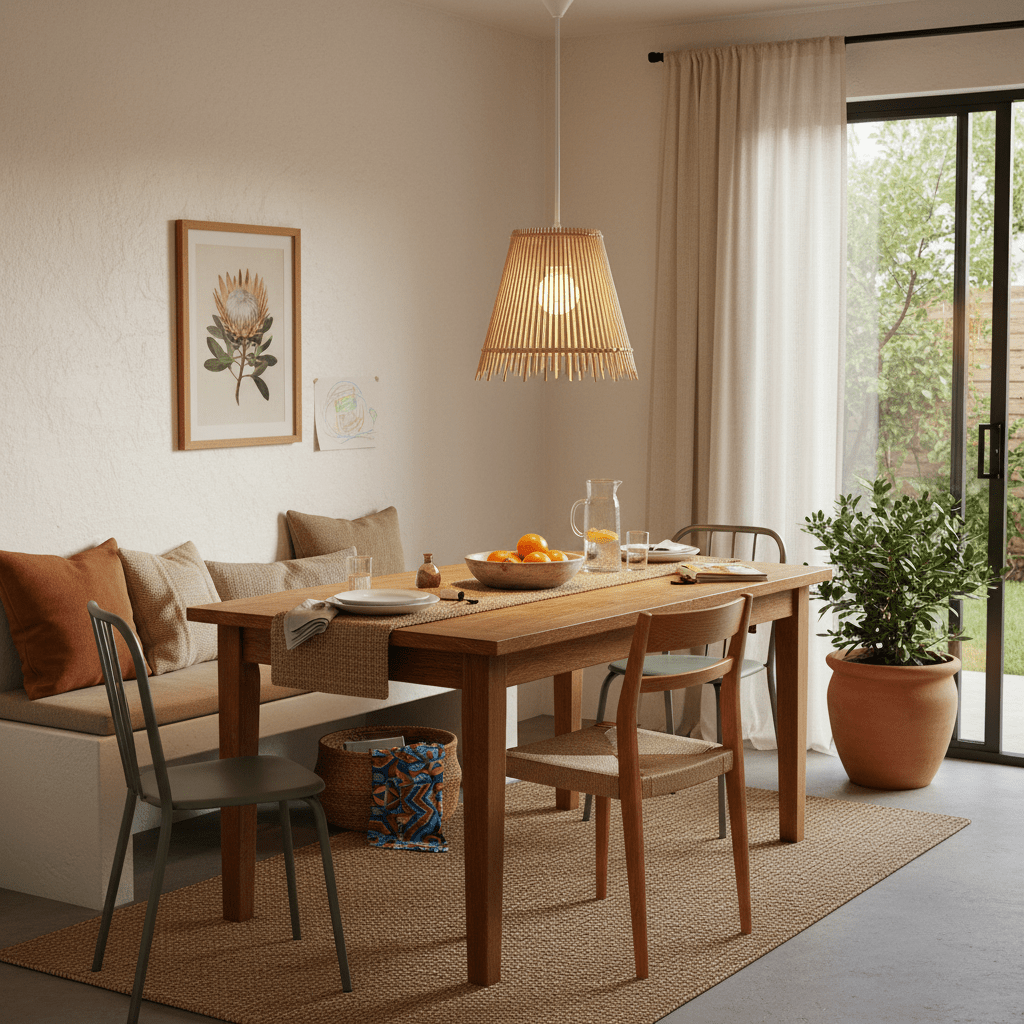
Once you line up size, quantity, and material with your table and décor, you’re more than halfway to a dining room that feels designed, not accidental.
What colour temperature, brightness, and bulbs are best for dining room pendants?
What colour temperature (CCT) creates the best dining room ambience?
For a dining room, warm white between 2700 K and 3000 K creates a cosy, flattering glow that’s ideal for everyday meals and weekend entertaining in South African homes.
Cooler light (4000 K and up) can feel clinical over a dinner table, making food look less appetising and skin tones harsher – fine for offices, not for your braai-night spread. Many of our Cape Town and Joburg clients who “don’t like warm white” discover they actually dislike cheap orange-tinted globes; a quality 3000 K LED is warm yet still crisp.
For multi-use spaces (homework at the table, remote work during the day) we often suggest dimmable 3000 K LEDs paired with a compatible LED dimmer, or tunable white bulbs that shift from 2700–4000 K. That way you can brighten and “cool” things slightly for tasks without sacrificing evening cosiness.
In short: Aim for warm white around 2700–3000 K for dining pendants; it flatters people and food and instantly feels more hospitable than cooler white options.

How bright should your dining room pendants be (lumens and watts)?
Most dining rooms feel comfortable with 2,000–4,000 lumens total, delivered by 8–12 W LED pendants (around 800–1,000 lumens each) combined with any background lighting.
As a simple benchmark: a 4–6 seater table usually works with one or two pendants at 8–10 W each; an 8–10 seater often needs two or three pendants at 10–12 W. If you have strong existing ambient light (for example, recessed downlights or nearby lounge lighting), the pendants can be slightly lower wattage and more decorative.
Remember, LED efficacy matters: a quality 10 W LED producing 1,000 lumens vastly outperforms an old 60 W incandescent at about the same brightness. Aim for at least 80–90 lumens per watt for good efficiency, especially in a country where we’re all watching electricity bills and planning around load-shedding schedules.
Bottom line: Size your pendant brightness to your table and room, targeting ±2,000–4,000 lumens total across pendants and surrounding fixtures for relaxed, usable light.

What CRI and bulb type make food and faces look their best?
Choose LED bulbs with a Colour Rendering Index (CRI) of at least 80, and ideally 90+, so skin tones and food look natural and appealing under your dining pendants.
CRI measures how accurately a light source reveals colours compared to natural light. Under low-CRI light, a beautiful curry or salad can look dull and greyish. Many of the newer LED filament bulbs we supply for pendants are CRI 90+, giving a warm, high-end restaurant feel even in a simple suburban dining room.
For most pendants we recommend E27 or E14 LED bulbs in warm white, 6–10 W each depending on shade design and number of fittings. If your pendant has an integrated LED module, check that it quotes CRI 80+ and at least 25,000–30,000-hour lifespan. For inspiration, have a look at our LED filament guide for entertainment areas – the same principles apply to dining.
Key takeaway: Prioritise CRI 80–90+ and warm-white LED bulbs so the people and food at your table look vibrant, not washed out or sickly.

When colour temperature, brightness, and CRI are dialled in, your dining room automatically feels more comfortable – like your favourite restaurant, just with your own playlist.
How high should you hang dining room pendants – and how do you avoid glare?
What is the ideal height to hang dining room pendant lights?
In most South African homes, pendants look and perform best when the bottom of the shade hangs about 75–85 cm above the dining table surface.
This height gives you an intimate pool of light while keeping sightlines clear across the table – nobody wants to lean around a pendant to see their guests. For standard 2.4–2.7 m ceilings, this usually means the pendant cable is adjusted so the fitting sits at around 150–160 cm from the floor.
With higher ceilings (3 m and up), you can cheat a little and hang them slightly higher for balance, but still keep at least 70 cm between table and shade. For more detailed diagrams and tips, we break it down step-by-step in our pendant height and placement guide.
In short: Use 75–85 cm above the table as your go-to hanging height, and adjust a few centimetres up or down for your ceiling height and personal preference.

How do you prevent glare and “spotlight in the eyes” from pendants?
Choose pendants with diffusers, shades, or frosted glass and position them correctly so you see soft glow, not bare LED points glaring into your eyes.
Glare is a common complaint when people upgrade to LEDs but keep old, clear glass fittings with exposed, ultra-bright bulbs. In South African dining rooms with lots of reflective surfaces (gloss tiles, stone counters, large windows), harsh point sources can be especially uncomfortable at night.
Look for pendants with opal glass, fabric, or metal shades that hide the bulb, or use frosted LED bulbs instead of clear filaments. Dimming helps too – bringing your 100 % output down to 40–60 % reduces glare and still gives enough lux over the table. A CRI 90 bulb at 6 W frosted can feel more pleasant than a clear 10 W in the same fitting.
Bottom line: Prioritise soft diffusion and proper positioning over raw brightness; your eyes (and guests) will thank you after a long dinner.

How do pendant layout and spacing affect overall dining room ambience?
Even spacing, centred over the table rather than the room, creates a balanced pool of light and makes the dining area feel intentional and inviting.
In many older South African houses, the ceiling point sits in the middle of the room, not above where the table now lives. The best fix is often to run a short surface conduit or a track and shift the pendant centreline so it’s exactly over the table. We’ve done this in many renovated homes in Durbanville and Bedfordview with excellent visual results.
When using multiple pendants, keep them evenly spaced – usually 60–80 cm apart – and aligned along the centre of the table. For rectangular tables, the end pendants should sit about 25–35 cm in from the table ends to avoid leaving the heads of the table in shadow.
Key takeaway: Always line up your pendants with the table, not the room; this simple shift dramatically improves both function and atmosphere.

With height, glare control, and spacing sorted, your pendants stop being random lights in the ceiling and start becoming a proper feature that anchors the whole space.
How do pendants compare to other dining room lighting options?
| Feature | Pendant Lighting | Recessed Downlights Only |
|---|---|---|
| Ambience over table | Creates decorative focal point and cosy pool of light. | Even but flat; lacks visual focus and atmosphere. |
| Glare control | Good with diffusers/shades at eye level. | Can cause overhead glare and shadows on faces. |
| Flexibility with table moves | Centred over table; moving table may misalign. | More flexible; whole room is evenly lit. |
| Design statement | High – a key décor feature. | Low – visually minimal. |
| Typical power use (LED) | 2–3 x 8–12 W fittings. | 4–6 x 5–7 W downlights. |
In most modern South African homes, the best solution is a mix: pendants over the table for ambience, plus subtle downlights or wall lights for background illumination.
Quick Checklist
- Confirm room size, table dimensions, and ceiling height to size your pendants correctly.
- Choose a warm colour temperature (2700–3000 K) for relaxed, inviting dining ambience.
- Pick LED bulbs with at least CRI 80, ideally 90+, so food and faces look natural and flattering.
- Ensure IP and material suitability for your environment, especially in coastal or dusty South African areas.
- Check dimming compatibility, wiring routes, and SANS-compliant installation with a qualified electrician.
Future Light has been lighting South African homes and restaurants for well over a decade, and we’ve seen how the right pendants can turn an “okay” dining room into a place where people linger happily. If you’re ready to find your perfect fit, browse our curated LED pendant light collection, explore our dedicated dining room lighting ideas, or dive deeper into whole-home planning with our ultimate indoor lighting guide. We’re always just a click away if you’d like personalised advice for your space.
Frequently Asked Questions
Q1: What is the best height to hang a pendant light over a dining table?
The ideal height is typically 75–85 cm above the table surface, which gives comfortable illumination without blocking views or creating glare for seated guests.
Q2: How many pendant lights do I need over my dining table?
Use one pendant for small round or square tables, and two or three evenly spaced pendants for longer rectangular tables over 1.8 m to spread light evenly.
Q3: What colour temperature is best for dining room pendant lighting?
Warm white between 2700–3000 K is best, as it creates a cosy, restaurant-like atmosphere and makes food and skin tones look more inviting and natural.
Q4: Do I need dimmable pendants in my dining room?
Dimmable pendants are strongly recommended because they let you switch from bright everyday meals to soft, intimate lighting for evening entertaining with one fitting.
Q5: What size pendant should I choose for my dining table?
A good rule is to choose a pendant that’s 50–70 % of the table’s width, ensuring it feels substantial without visually overpowering the table or room.
Q6: Can I use LED bulbs in any dining room pendant?
You can use LED bulbs in most pendants with standard E27 or E14 lampholders, provided you match the wattage limit and check dimmer compatibility if you plan to dim.
Q7: Should my pendant be centred in the room or over the table?
Always centre your pendant over the dining table, not the room, because the table is the focal point and needs balanced, symmetrical lighting for the best effect.
Q8: Is it safe to install pendant lights myself?
For safety and SANS compliance, a qualified electrician should handle any new wiring, but confident DIYers can sometimes swap fittings on an existing point with power isolated.


