



Outdoor Wall Lights for Bright and Stylish Entrances
Your entrance says plenty before anyone rings the bell. In South Africa, where we often arrive home after dark, entertain outdoors, and want a front door that feels both welcoming and secure, the right outdoor wall light does serious heavy lifting.
A good entrance light should help visitors find the gate, make keys easier to use, flatter the architecture, and improve peace of mind without turning your home into a harsh floodlit parking area. That balance between brightness and style is exactly where outdoor wall lights shine.
At Future Light, we’ve seen this firsthand across everything from modern Johannesburg cluster homes to Durban coastal properties and Cape Town apartments with exposed sea air. One of the most common customer patterns is simple: people start by looking for “something brighter,” then realise the best result comes from matching light output, beam shape, colour temperature, and IP rating to the entrance itself.
That practical, experience-led approach matters. A stylish fitting that rusts too quickly near the coast, glares into guests’ eyes, or leaves your lock in shadow is not a good buy, even if it looked smart in a product photo.
Key Takeaways
- Choose outdoor wall lights that combine welcoming brightness with controlled beam direction for safer, more attractive entrances.
- For most front doors, 3000K warm white, CRI 80+ or better, and roughly 600–1200 lumens per fitting works well.
- Install lights at practical heights around 1.8m to 2.2m, keeping the lock, step edge, and doorbell area clearly visible.
- Up-and-down, lantern, bulkhead, and diffused wall lights each create a different architectural effect and brightness feel.
- South African coastal, rainy, dusty, and sunny conditions make IP ratings and corrosion resistance especially important.
- Buying the right fitting means checking style, output, IP level, maintenance requirements, and compatibility with sensors or timers.

How bright should outdoor wall lights be for an entrance?
The ideal entrance wall light is usually bright enough to illuminate faces, locks, steps, and door signage without producing harsh glare, which for most homes means roughly 600 to 1200 lumens per fitting.
That range suits many South African front doors, townhouse entrances, and covered stoep areas. A compact apartment landing might need only one neat wall light around 500 to 800 lumens, while a double-volume entrance or wide pivot door often benefits from two fittings, one on each side, to create balanced visibility.
Wattage matters less than output now that LED technology is so efficient. As a rule of thumb, many quality LED wall lights delivering entrance-friendly brightness use around 8W to 15W. If your entrance includes stairs, house numbers, a gate path, or a dark overhang, consider layering the wall lights with bollards, step lights, or pathway lighting from the outdoor lighting collection.
In short: For most stylish and practical entrances, aim for controlled LED brightness in the 600–1200 lumen range per wall light.

What colour temperature works best for front doors?
Warm white between 2700K and 3000K is usually best for front doors because it feels welcoming, shows materials beautifully, and avoids the cold, clinical look many homeowners dislike at entrances.
That is especially true on timber doors, facebrick, textured plaster, natural stone, and black architectural finishes. In our local market, 3000K is often the sweet spot for stylish entrances because it still gives crisp enough visibility for modern homes while keeping the mood inviting. Neutral white 4000K can work where a more contemporary or security-focused look is needed, particularly in commercial entrances or minimalist estates.
For colour quality, we recommend CRI 80+ as a minimum, with CRI 90+ being even better if you want skin tones, plants, paint colours, and natural finishes to look richer. This is one of those small technical details that makes a visible difference in real life, especially when guests arrive at night and the entrance is one of the first spaces they experience.
In short: Choose 2700K–3000K for warmth and style, and look for CRI 80+ so your entrance materials and colours read properly.

Need a quick entrance lighting shortlist?
Browse fittings designed specifically for external walls, entry points, patios, and gate areas.
Does beam angle matter for entrance lighting?
Yes, beam angle matters because it determines whether your entrance light creates practical visibility, decorative wall washing, or an overly narrow patch of brightness that leaves key areas dark.
Narrow beams, often around 20° to 40°, are great for dramatic up-and-down architectural effects on tall walls. Wider beams, roughly 60° to 120°, usually work better where you need comfortable face recognition, easier key access, and less contrast around the door. Diffused fittings spread light more softly and can be the better choice for small porches and compact apartment entrances.
An installer once told us one of the most common entrance mistakes is placing a beautiful narrow-beam fitting next to a front door and then wondering why the handle is still in shadow. That rings true. If the fitting is decorative, make sure it also lights the task area. If not, supplement it with a second source or choose a more diffused model.
In short: Narrow beams create drama; wider beams improve practical entrance visibility and usually feel easier to live with.

| Entrance Lighting Factor | Best Practical Range | Why It Works |
|---|---|---|
| Lumens | 600–1200 lm per fitting | Good balance of visibility and comfort for most homes |
| Colour temperature | 2700K–3000K | Warm, inviting, and flattering to finishes |
| CRI | 80+ minimum, 90+ ideal | Better colour rendering for people, paint, stone, and timber |
| Beam angle | 60°–120° for most entrances | Improves usable spread around the doorway |
| IP rating | IP44 to IP65+ | Helps weather resistance in exposed outdoor conditions |
A stylish entrance should feel bright enough to be useful, but never so bright that it kills the welcome.
Which outdoor wall light style is best for a stylish entrance?
Are up-and-down wall lights good for entrances?
Up-and-down wall lights are excellent for stylish entrances when you want a modern architectural look, but they perform best when their beam spread also supports practical visibility near the door.
These fittings are popular on contemporary Johannesburg homes, estate entrances, and renovated townhouses because they create neat vertical light patterns on plaster, stone cladding, and painted exterior walls. They work especially well where the façade needs visual structure at night. On a wide entrance wall, using two matching fittings can make the whole elevation feel more intentional and premium.
However, not all up-and-down lights are equal. Some are highly decorative with tight beams, while others include broader diffusion or integrated front throw. For exposed weather, look for at least IP54, and for harsh rain or dust exposure, IP65 offers stronger protection. In coastal areas, fittings labelled coastal-suitable or with corrosion-resistant finishes are worth prioritising, such as those you’ll find in selected LED outdoor wall lights.
In short: Up-and-down lights are ideal for modern style, provided they also deliver useful spread where people actually stand and move.

Future Light trust note
We regularly help customers compare attractive fittings that look similar online but behave very differently once installed. Beam shape, glare control, coastal suitability, and maintenance access often matter more than the photo suggests.
Should you choose lantern, bulkhead, or minimalist wall lights?
The best style depends on your architecture, because lanterns feel classic and welcoming, bulkheads feel durable and practical, and minimalist wall lights suit clean contemporary entrances.
Lantern-style lights work beautifully on cottage, farmhouse, heritage, and hospitality-style properties, including guesthouses and lodges where character matters. Bulkhead lights are often underrated; on side entrances, service doors, apartment blocks, and modern utility areas, they offer robust diffusion and dependable weather resistance. Minimalist cube and cylinder fittings are the go-to for crisp, modern homes and often pair well with black window frames and large timber doors.
Style should still support function. If your entrance wall is narrow or close to a gate pillar, a compact fitting may sit better. If there is no overhead cover, a tighter, better-sealed fitting usually ages better. If you need a coordinated look across the façade, compare adjacent categories like entrance and foyer lighting for design continuity.
In short: Match the fitting style to the building character, but never sacrifice weather resistance and usable light distribution.

Can outdoor wall lights improve security without looking harsh?
Yes, outdoor wall lights can improve security elegantly by increasing facial visibility, reducing dark pockets, and making entrances easier to monitor without relying on cold, glaring floodlights.
For many South African homes, the best solution is layered lighting: a welcoming wall light at the door, plus motion-triggered or perimeter lighting further out. This avoids the common problem where the front entrance looks lovely but the gate path or parking bay remains dark. Motion sensors are especially useful at side entrances, garage access doors, and Airbnb check-in points.
If you want smart control, timers and sensors can help maintain convenience and energy savings. Products in motion sensors and day-night timer switches can support this approach, while a dedicated read through the security lighting solutions page helps if your entrance forms part of a broader safety plan.
In short: Good entrance lighting supports security best when it is layered, controlled, and bright enough to reveal faces and movement comfortably.

The best-looking entrance lights are usually the ones that make people feel comfortable without noticing why.
What IP rating and installation details matter in South Africa?
What IP rating do outdoor entrance wall lights need?
Most outdoor entrance wall lights should be at least IP44, while more exposed positions in driving rain, coastal spray, or dusty open areas are safer with IP54 to IP65.
An under-cover front door in a townhouse complex may cope well with IP44, provided the fitting quality is decent and the junction is properly sealed. But if the wall gets direct weather, if the fitting sits near a gate pillar, or if you’re working in windy coastal conditions like parts of Durban or the Western Cape, higher ingress protection is a wise upgrade.
IP ratings cover resistance to solids and water ingress, but they do not tell the full story about corrosion. Coastal suitability, marine-grade finishes, powder coating quality, gasket quality, and stainless hardware all matter too. This becomes especially important within salty air zones near the coast, where low-grade fittings can age badly even if the IP number looks acceptable.
In short: Use IP44 for sheltered areas, but choose IP54 to IP65 for more exposed South African entrance conditions.

Quick specification card
- Covered front door: IP44 minimum
- Exposed entrance wall: IP54–IP65 preferred
- Typical colour temperature: 3000K
- Recommended CRI: 80+ minimum
- Comfortable entrance output: 600–1200 lumens
Where should outdoor wall lights be installed around the door?
Most entrance wall lights look and work best when mounted around 1.8m to 2.2m above finished floor level, adjusted to suit door height, overhangs, and whether the fitting is decorative or task-focused.
For a single light beside the door, align it so the beam helps with lock visibility and face recognition. For double doors or wider entry walls, symmetrical placement often creates a more premium look. If the fitting throws light strongly upward, make sure there is enough wall area above it for the effect to breathe; otherwise it can feel cramped and wasted.
Real-world installer insight: always check the opening direction of the door, intercom position, security gate, and house number before final placement. We’ve seen plenty of entrances where the fitting looks centred on paper but ends up shining straight into a security gate frame or getting blocked every time the door opens. If connections need protection, use proper outdoor-rated components such as waterproof junction boxes where suitable.
In short: Good placement is usually around eye-to-head height, but real entrance hardware and movement patterns should guide the final position.

Should you use integrated LED, replaceable bulb, solar, or sensor options?
Integrated LED fittings are often the neatest and most efficient choice for modern entrances, while replaceable bulb fittings offer easier future lamp changes and more flexibility in colour temperature and output.
If aesthetics matter most, integrated LED wall lights usually give cleaner lines and better beam control. If you prefer serviceability or want to swap bulbs later, lamp-based fittings with compatible bulbs from the LED bulbs collection remain a solid option. Solar can work well where wiring is difficult, especially at gate pillars or rental properties, but front entrance solar performance depends heavily on sunlight exposure and battery quality. If load shedding resilience matters, look at complementary loadshedding lighting solutions too.
Sensors make sense where hands-free activation helps, particularly side doors, parking access, and high-traffic entry points. Just make sure the sensitivity and duration are tuned properly. Constant false-triggering from pets, passing vehicles, or wind-blown plants gets annoying very quickly.
In short: Integrated LED suits sleek design, replaceable bulbs suit flexibility, and sensors or solar are best chosen by site conditions, not trend alone.
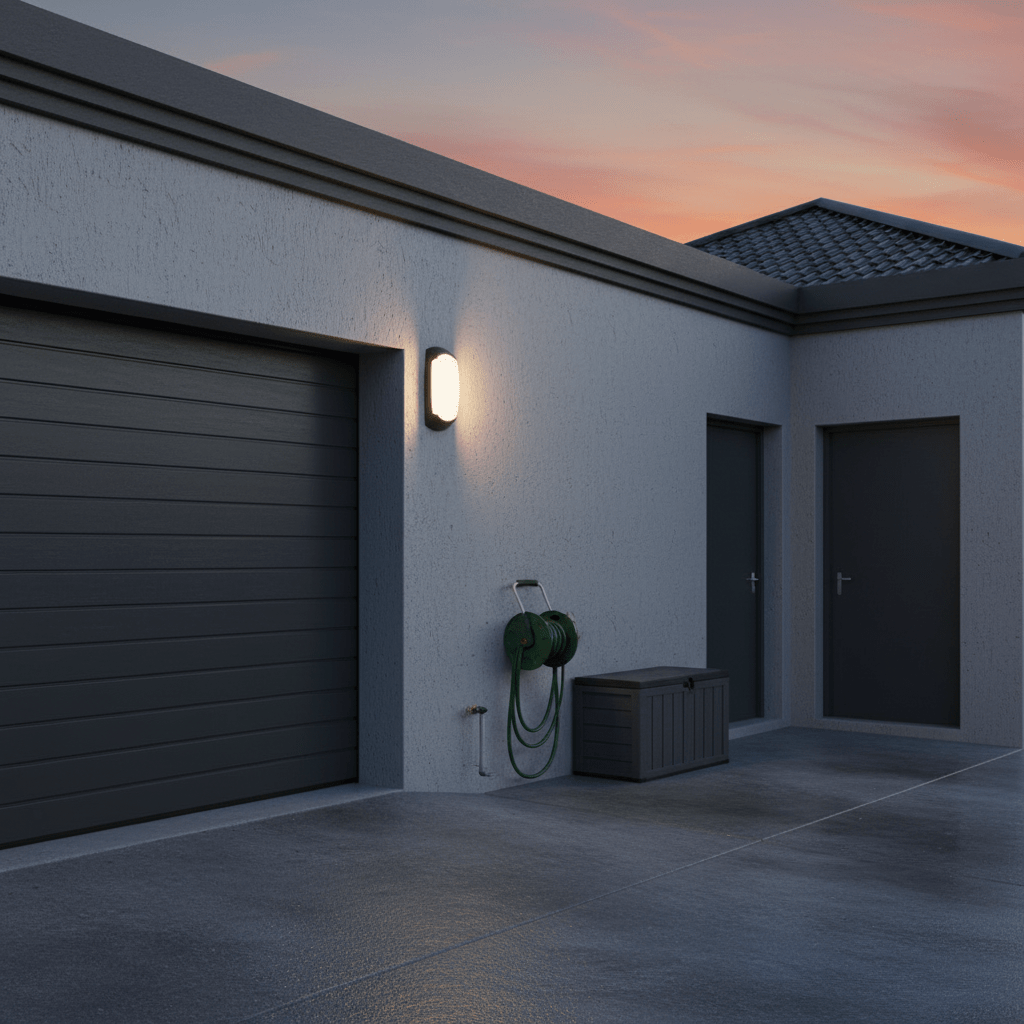
In South Africa, a good entrance light does not just survive the weather; it also has to survive real daily use.
How do you choose the right outdoor wall light for your entrance?
What should you check before buying?
Before buying, check brightness, colour temperature, CRI, IP rating, material quality, dimensions, beam direction, and whether the fitting suits the actual scale of your entrance wall.
It helps to stand outside at night and assess what the entrance really needs. Is the priority stronger lock visibility, better style, a softer welcome, improved security, or all four? A compact light might disappear on a large double-volume façade, while an oversized fitting can overpower a townhouse door. If your entrance opens onto a patio or covered outdoor entertaining area, it is also worth browsing related looks in patio lighting for a more cohesive result.
Another trust point worth mentioning: quality outdoor fittings tend to show their value over time, not only on day one. Better finishes resist fading, better diffusers stay cleaner-looking, and better driver quality tends to support more stable LED performance. That matters in our strong sun, dust, humidity, and seasonal storms.
In short: Buy for the actual entrance conditions and scale, not just the prettiest fitting on the screen.

Helpful buyer checklist
Use this as a fast filter before adding anything to cart:
- Is the light bright enough in lumens?
- Will 3000K suit the entrance finishes?
- Is CRI 80+ or better?
- Is the IP rating right for exposure level?
- Does the beam reach the handle and steps?
- Will the finish cope with your local climate?
Can you create a premium entrance look on a practical budget?
Yes, a premium-looking entrance is absolutely possible on a sensible budget when you prioritise proportion, finish quality, and beam control instead of chasing the biggest or most complicated fitting.
One well-chosen wall light can outperform two cheap fittings that glare, fade, or look undersized. Matte black, textured charcoal, anthracite, and soft opal diffusers tend to look refined across many South African architectural styles. Pairing a clean wall light with a tidy switch or sensor arrangement often has more visual impact than adding unnecessary decorative extras.
If you are trying to keep costs under control, think in phases. Start with the entrance wall lights, then add pathway, gate, or garden support later. Browsing value-led categories like lighting under R500 can help, but focus on specification, not price alone. The best budget choice is the one you do not have to replace too soon.
In short: A premium entrance feel comes from balance and restraint, not from overspending on the flashiest fitting available.

What is the smartest all-round choice for most South African entrances?
The smartest all-round choice for most South African entrances is a warm white 3000K LED wall light with 600 to 1200 lumens, CRI 80+ or higher, and at least IP54 if the area is weather-exposed.
That formula covers most modern houses, complexes, guesthouse entrances, and practical family homes. It gives enough brightness to handle everyday use, enough warmth to remain inviting, and enough technical reliability to cope with real outdoor conditions. If you live near the coast, step up the corrosion resistance. If the entrance is tiny, choose diffusion over size. If the wall is large, use symmetry or a fitting with stronger visual presence.
For homeowners who want to tie entrance lighting into the rest of the home, it is worth exploring adjacent guidance such as how to use wall lights properly and the broader indoor lighting guide, so your front door does not feel disconnected from the inside experience.
In short: The safest winning formula is warm, well-rendered, weather-appropriate LED light with enough brightness to be useful and enough restraint to stay stylish.

A great entrance light should make coming home feel easier, safer, and just a little more special every night.
Quick entrance lighting checklist
- Brightness: Aim for roughly 600–1200 lumens per fitting for most entrances.
- Colour temperature: Choose 2700K–3000K for a welcoming look; use 4000K only if you want a crisper feel.
- CRI: Go for CRI 80+ minimum; CRI 90+ gives better material and skin tone rendering.
- IP suitability: IP44 minimum for sheltered spots, IP54–IP65 for exposed areas.
- Beam control: Make sure the lock, threshold, and first step are actually lit.
- Placement: Typical mounting height is about 1.8m–2.2m, adjusted to site conditions.
- Climate: Coastal homes need corrosion resistance, not just a decent IP number.
- Controls: Add sensors or timers where convenience and security overlap.
Need help choosing?
If you are comparing styles, trying to match a gate light to a front door, or unsure about coastal suitability, it helps to narrow the options with a practical eye.
Choosing outdoor wall lights for bright and stylish entrances is really about getting the basics right: enough useful brightness, a flattering warm colour temperature, decent CRI, a weather-ready IP rating, and a design that suits your home rather than fighting it. Do that well and your entrance works harder every evening, whether you are welcoming guests, unloading groceries, or simply arriving home after a long day.
For more inspiration and practical buying support, browse the LED outdoor wall lights collection, explore the ultimate outdoor lighting guide, or compare broader options in the outdoor lighting range. If your project includes a full entrance upgrade, Future Light can also help you think through the practical details before you buy.
Frequently Asked Questions
How many lumens do I need for an outdoor wall light at my front door?
Most front doors work well with about 600 to 1200 lumens per fitting. Smaller sheltered entrances may need less, while large or double-door entrances may need two fittings for balanced light.
What colour temperature is best for stylish entrance lighting?
Warm white between 2700K and 3000K is usually the best choice. It feels welcoming, flatters natural materials, and gives a more premium look than harsh cool white lighting.
Is 4000K too cool for a home entrance?
4000K is not always too cool, but it can feel more clinical than warm white. It suits some very modern or security-led entrances, though 3000K is usually more inviting.
What IP rating should an outdoor wall light have?
IP44 is the usual minimum for sheltered outdoor entrances. If the fitting is exposed to rain, wind, dust, or coastal conditions, IP54 to IP65 is a safer choice.
Are up-and-down wall lights bright enough for a front door?
They can be, but only if the beam spread and light output are suitable. Some up-and-down fittings are decorative first, so always check that the door handle and threshold will be lit properly.
What CRI is good for outdoor entrance wall lights?
CRI 80 or above is a good standard for outdoor entrance lighting. If you want finishes, plants, and skin tones to look richer, CRI 90 or above is even better.
Can I use solar wall lights at an entrance?
Yes, if the location gets enough sunlight and the product has reliable battery performance. Solar is especially useful where wiring is difficult, but output and consistency vary by position and season.
Where should I mount an outdoor wall light beside the door?
Most are installed around 1.8m to 2.2m above finished floor level. Final height should also account for glare, door swing, intercom placement, and whether the fitting needs to light the lock and steps.


