


Reading beside a bed or chair
Check direction, switch position, reach and projection. The beam should fall on the book or task area rather than behind your shoulder.

Zero Spam Promise!
Future Light room-by-room guide
Use wall lighting to soften harsh ceiling light, make reading and circulation more comfortable, and give living spaces a deliberate evening layer. Start with the job the fitting must do, then compare the shape, light direction, installation method and product details.
Start with the job
Wall lights are easier to compare once the job is clear. Reading, ambient light and feature-wall illumination call for different shapes and light directions.
Check direction, switch position, reach and projection. The beam should fall on the book or task area rather than behind your shoulder.
Look for a shaded or diffused fitting when you want a calm evening layer without a bright source at eye level.
Use the wall as part of the lighting effect. Confirm the spread and mounting position so the light reaches the detail without glare.
Three useful directions

For passages, feature walls and work settings
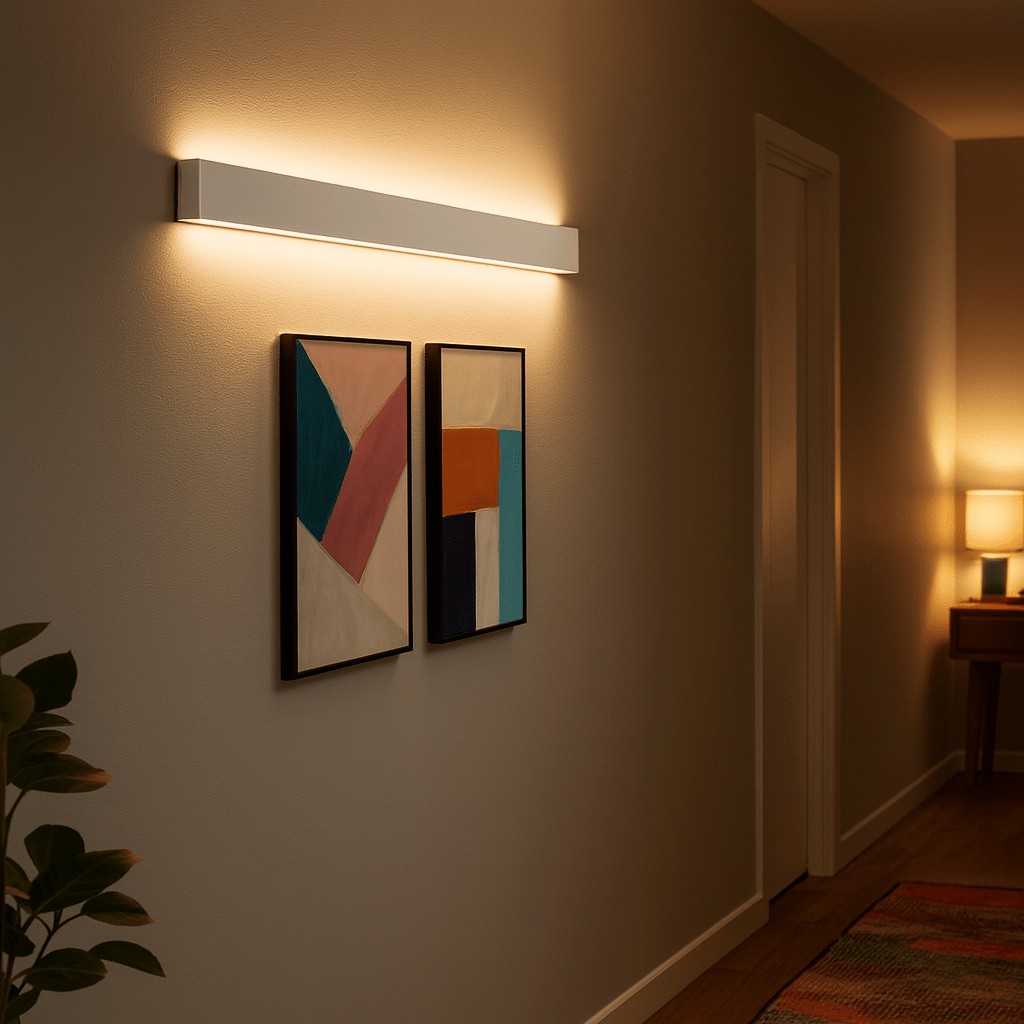
The aluminium and polycarbonate AVICO uses integrated 40W LED light with a stated 6000 lm output, 4000K colour temperature, 230V supply and IP20 rating. Its long linear form suits a wall where even, direct illumination matters.
Use it where a passage, boardroom or feature wall needs a strong visual line and the fitting will remain in a dry indoor environment. Confirm the 1508 mm length and the mounting position before ordering.
View AVICO wall light


For bedrooms, lounges and passages
This ceramic fitting uses opal glass and an E14 lamp holder on a 230V supply. Its off-white and blue-grey finish gives the wall more texture while the opal glass softens the light.
It suits a bedroom, passage or living area where the fitting needs to contribute to the room rather than act as a concentrated task light. The listed IP20 rating means it is intended for dry indoor placement.
View the ceramic wall light


For bedside reading, sofas and small desks
This metal wall light uses a cord and inline switch, so it can add light beside a bed, sofa or desk without hardwiring. It accepts an E27 bulb and is rated IP20 for dry indoor use.
The 450 mm depth needs checking beside furniture, but the plug-in format can make sense when a suitable fixed wiring point is not available. The listing states 40W maximum and recommends an 11W LED bulb.
View the plug-in wall light

Placement decisions
| Room or job | Check first | Why it matters |
|---|---|---|
| Bedside reading | Reach, switch position, projection and beam direction | The light must reach the page without shining into the reader’s eyes. |
| Lounge or passage | Diffusion, spacing and eye-level glare | Wall lighting should add a comfortable layer alongside the ceiling light. |
| Artwork or textured wall | Spread, mounting height and viewing angle | The wall should be lit evenly without putting the brightest point in the viewer’s line of sight. |
| Bathroom or humid area | IP rating, installation zone and wiring | Indoor IP20 products are not a default choice near splashes. Confirm suitability with a qualified installer. |
Before installation
Record the fitting’s width, height and projection, especially beside a bed, sofa or narrow passage.
Check integrated LED or replaceable bulb, then confirm cap, wattage and colour temperature on the product page.
These formats solve different retrofit problems. A qualified electrician should complete fixed mains wiring.
Use the stated IP rating and installation guidance for the actual room and position.
Place the control where the light will be used, not behind a headboard or furniture.
Need a second opinion?
Include a quick photo, the intended use and any product you are considering. We can help you narrow the choice without guessing at fit or compatibility.
Practical answers
There is no single height for every fitting. Check the product dimensions, furniture, expected eye line and beam direction before marking the position.
They are usually one layer of the plan. A fitting may cover a narrow task or passage area, while a larger room often needs more than one light layer.
A plug-in model can suit some retrofit or rental situations. Fixed mains wiring should be planned and completed by a qualified electrician.
Next step
Browse the indoor wall-light collection when you know whether you need reading light, softer ambience or a more structured feature-wall effect. If the room, dimensions or wiring point are unclear, contact the team before choosing.