



There’s nothing quite like kicking back on your veranda with a cold drink in hand and the smell of braai in the air — until the summer sun turns that dream space into a stifling oven. That’s where a roof-mounted ceiling fan can make all the difference, offering both comfort and flair to your outdoor living area.
At Future Light, we’ve helped thousands of South Africans transform their patios, braai areas, and balconies with smart ceiling fan installations. One Cape Town customer, Uncle Faizel from Bellville, came to us frustrated by his guests wilting before the sosaties finished grilling. We helped kit out his veranda with an IP-rated fan and warm LED ambient lighting — and now, it’s the “lekker” hub of the whole block!
Key Takeaways
- Ceiling fans offer cost-effective veranda cooling for South African climates.
- Choose outdoor-rated fans with IP44 or higher for durability in wind and moisture.
- Consider blade material, mounting height, and airflow direction for best results.
- LED-integrated fans add style, efficiency, and nighttime visibility.
- Cape Town to Polokwane — ceiling fans suit every SA region with proper spec’ing.
- A quality fan integrates smart lighting and breeze to enhance your patio experience.

Choosing the Perfect Ceiling Fan for Your Veranda
Outdoor Ratings Matter: Stay IP Smart
When deciding on a veranda ceiling fan, you can’t ignore our moody South African weather. Between Joburg’s summer storms and Knysna’s salty sea air, your fan needs serious staying power. It’s like fitting off-road tyres on your bakkie — outdoor ceiling fans need the right specs to handle exposure. Look out for IP44 and up for solid moisture and dust protection.
At Future Light, we’ve seen many a coastal customer replace rusted fans within a year. That changed when we started stocking outdoor-rated brands like K-Light and Brightstar. For those unsure how the protection ratings align to performance, we've found this IP rating guide very handy.
A solid outdoor fan should not only carry an IP44+ rating but also feature sealed motor housings. Look for ABS plastic or stainless-steel blades in humid regions, and watch out for any signs of rust vulnerability. Combine this with an LED alternate like a built-in downlight and you’ve added both cooling and classy illumination in one install.
Micro Summary: Outdoor ceiling fans must be weatherproof — look for IP44+ to withstand rain, dust, and salt air.

Blade Types and Materials to Tame the Breezes
South African homes can’t rely on one-style-fits-all for fan blades. A covered stoep in Paarl needs something different from a wind-whipped deck at the Vaal Dam. Wooden blades can warp in humidity, while metal fans can corrode inland. ABS plastic is a local favourite – lightweight, UV resistant, and maintenance-light, making it perfect for 80% of locations.
We guided a customer in Durban North through choosing an ABS 3-blade fan for a breezy, salt-air patio, paired with LED filament bulbs from our bulb collection. The visual warmth was so good, they came back to install fans in their stoep braai area too. For balanced moves, opt for wider blades that slice air gently rather than speed demons that howl like Midlands wind. Here’s a handy government-backed tip sheet for airflow measurement.
Compare by sweep size, blade angle (pitch), and material: metal (precise, but loud); wood (stylish but complex), and ABS (ideal balance). Align this with CRI 80+ for lighting, CCT of 3000K–4000K, and IP ratings for full coverage.
Micro Summary: The right blade design dramatically improves airflow — ABS blades fare best in most SA outdoor settings.

Fan Sizing and Airflow Direction for Every Veranda Type
The size of your fan matters, especially outdoors. Under-specced and your guests will still be wilting. Over-specced and you’ll feel like you’re in a gusty Karoo dust storm. Short verandas such as those in many Parkhurst homes do well with 48-inch models, while larger farm verandas near Stellenbosch need 56-inch and above with decent oscillation or dual installations.
One customer in Claremont wanted two fans installed side-by-side for their long stoep, but we recommended a single 60-inch option with a clever reversible motor. These motors let you switch airflow – pushing air down in summer for cooling, or drawing it up in winter for circulation. Interested? Dive into our South African ceiling fan guide and check out aligned climate references from SA Weather Service.
Pair size and type properly: 1–2 blade options under 48" for tight balconies, 3–5-blade wide sweep for covered patios. Reversible fans also welcome paired smart tubes from our LED tube collection to add versatility.
Micro Summary: Match fan size and blade sweep to veranda dimensions while using reversible motors for seasonal efficiency.

Picking the right ceiling fan hinges on mastering your space’s dimensions, blade material, and regional climate quirks.
Lighting Integration & Control for Outdoor Comfort
Combining Ambient Lighting with Fan Function
A roof-mounted ceiling fan doesn’t just cool — it can be the star of your veranda’s lighting. Opt for integrated LED fans that combine breeze and brightness into one clean fixture. Think of it like a bakkie with a smart canopy — multipurpose, sleek, and efficient. Durban evening braais demand warm ambient lighting, so aim for CCT around 3000K and CRI of 80+.
We recently helped a Bryanston client with dimmable fan lighting using LED dimmable downlights around the fan unit. The vibe? Magic under the Lowveld stars. You’ll find more pairing ideas in our outdoor lighting guide. For detailed product behaviour, consult this lighting controls reference.
Choose fans with a 3000K–4000K range, built-in dimming, and smart switch compatibility. Add extras from our controls kit to allow mood-changing brilliance.
Micro Summary: Lighting-integrated fans enhance comfort while serving as your veranda’s lighting centrepiece.

Remote Control, Automation & Smart Fan Ideas
Why walk over to a switch when you can control your fan and light separately with the same remote or app? Modern ceiling fans are smart-enabled, some with Wi-Fi or Bluetooth support. In tech-savvy Sandton, customers are syncing fans with Google Home or Home Assistant setups. Make your veranda as clever as your lounge.
We fitted a smart fan setup in Pietermaritzburg using daylight-sensing triggers from our timer switch range and wall-synced fans from the smart fans collection. For installation standards, we referenced this formal SA wiring guide.
If you’re pairing to smart lighting like motion sensors from our sensor range, ensure your fan supports automation syncing and has enough dimming memory to maintain ambient levels.
Micro Summary: Modern fans offer smart control, automation pairing, and better energy management for outdoor use.

Keeping Installation Neat and Compliant
No amount of lighting flair will save a fan with messy wiring and exposed mounting on a tiled roof. Neatness counts, but so does compliance. Choose junction-ready lighting boxes and support brackets matched to fan weight and Swartland wind behaviour. Use secure PVC conduit for weather resistance and protect wiring underneath eaves.
Future Light’s quick-connectors from our WAGO collection simplify these jobs. We've learnt from expert contractors — one from George — who always pairs fans with weatherproof junction boxes. Be sure to reference SA’s contractor standards for dedicated circuits.
Always prep with IP65 box ratings, cables suitable for the CCT output (low-heat LEDs preferred), and CRI above 80 to avoid motion blur on moving blades. Aesthetically, include LED backlighting or halo trims.
Micro Summary: Safe and neat fan installation in SA requires the right mounting, waterproofing, and cable supports.
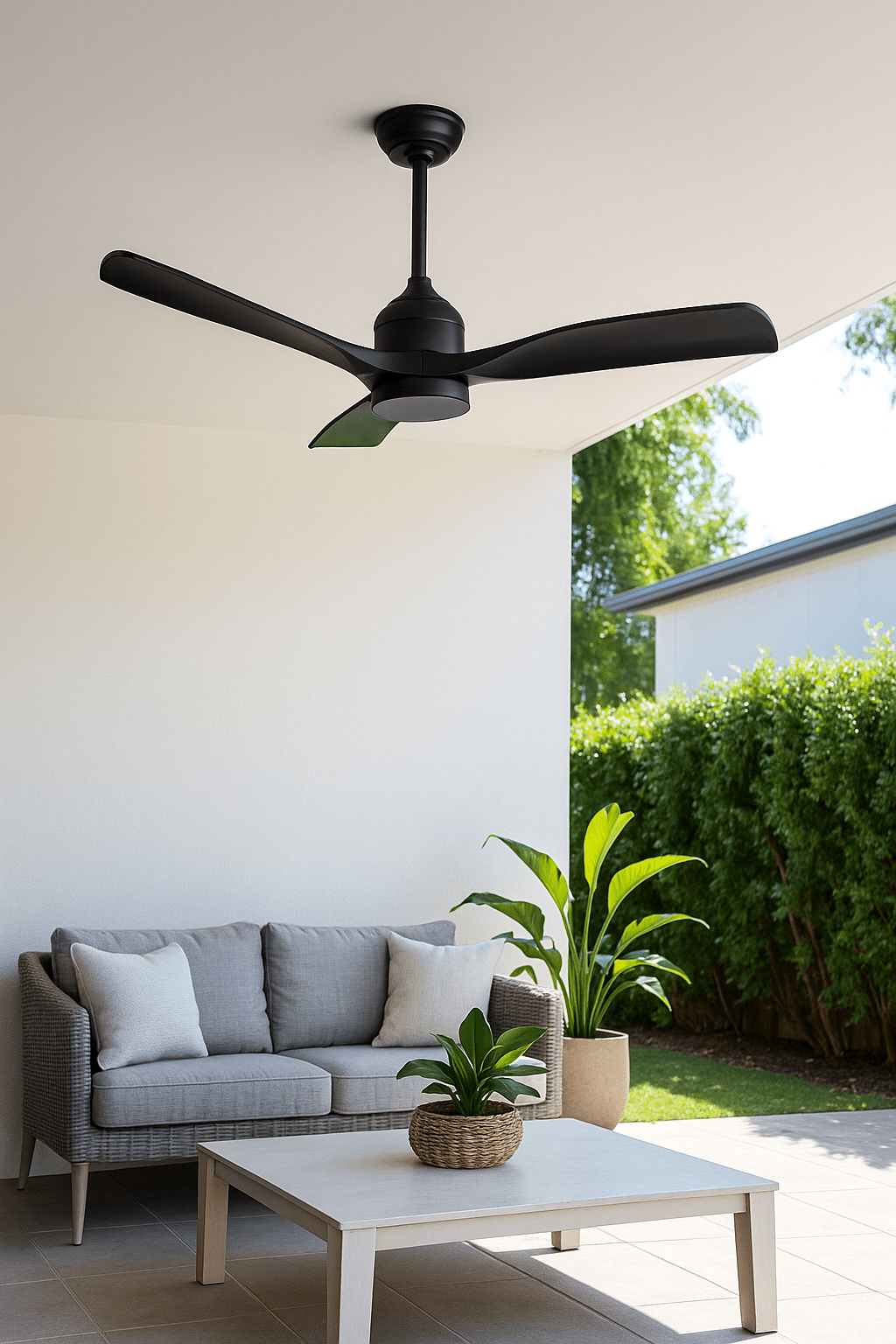
Smart, stylish, and safe fan installs create breeze and brilliance without sacrificing your veranda’s personality.
Quick Checklist
- Pick an IP44+ outdoor-rated ceiling fan
- Choose ABS blades for heat and moisture resistance
- Match fan size to veranda dimensions (48”–60”)
- Select integrated LED lighting with CRI 80+ and 3000K-4000K output
- Install using waterproof conduit + certified connectors
Keen to elevate your veranda comfort? Explore our full ceiling fan collection, find your favourite hero fan here, or explore this helpful blog guide to make veranda upgrades a breeze.
Frequently Asked Questions
Q1: Can I use an indoor fan outdoors on my veranda?
No — indoor fans lack the weatherproof sealing needed for rain, humidity, and dust. Use fans with a minimum rating of IP44 for outdoor use in South Africa.
Q2: What size ceiling fan do I need for a 20m² veranda?
Typically, a 52–56 inch fan works well for a 20m² space, offering sufficient airflow without causing a cyclone effect. Always match to ceiling height and openness.
Q3: Can I control my veranda fan with a remote?
Yes! Many fans support remote operation or smart home integration, allowing light-and-fan controls from a remote, smartphone, or automation panel.
Q4: Which materials are best for outdoor fan blades?
ABS plastic performs best outdoors in SA as it's moisture, UV, and rust-resistant. Avoid wood unless fully sealed; metal blades may corrode in coastal regions.
Q5: Are combined ceiling fans with lights effective for verandas?
Absolutely. Combo units save space and wiring, offer ambient lighting, and come in 3000K–4000K for mood-flexibility, often dimmable and integrated.
Q6: What installation height is best for ceiling fans?
Mount the fan at least 2.3 metres off the ground. Use downrods for higher ceilings to ensure optimal airflow without compromising aesthetics or safety.
Q7: Can I use LED bulbs in my ceiling fan?
Yes, LED bulbs are optimal for energy-saving, cool lighting. Choose warm white (3000–3500K) for verandas and ensure the bulb holder matches the fan spec.
Q8: Do I need a certified electrician to install a ceiling fan?
For outdoor fans, especially in covered patios, it's safest to hire a certified electrician to ensure SABS-compliant installations with correct weatherproof fittings.


