



There’s something deeply satisfying about stepping into a home where every detail whispers care and creativity. In many South African homes, staircases often take a back seat—left as mere connectors between levels instead of the stylish, functional features they can be. That’s where ambient step lights come in: a subtle but powerful upgrade that merges safety and sophistication in one gorgeously lit package.
Not long ago, Future Light worked with a family in Paarl renovating their hillside home. Their staircase was beautiful—but dim at night, particularly dangerous for their toddler and ouma. We introduced energy-efficient LED step lights that not only illuminated every tread but set a graceful glow throughout the entire stairwell. Not only safer—suddenly stunning.
Key Takeaways
- Ambient step lights enhance safety on indoor and outdoor staircases
- LED technology offers efficiency, style, and minimal maintenance
- Warm or cool CCT choices help define atmosphere and function
- Installations vary from recessed to surface-mounted and solar options
- Placement, beam angle and CRI directly influence visibility and ambience
- Perfect for South African homes seeking modern upgrades with purpose

Why Ambient Step Lights Matter for Safety & Style
Preventing Trips and Falls with Targeted Illumination
Picture your gran climbing stairs during load shedding with only a cellphone light to guide her—risky, right? That’s exactly the kind of hazard ambient step lights eliminate. By casting low-glare light across each tread, visibility is improved without overwhelming brightness. In homes across South Africa—from Sandton penthouses to coastal Knysna cottages—these lights subtly map out steps to minimise accidents in low-light conditions.
One family in Ballito upgraded their staircase with IP65-rated LED step lights positioned along the side wall. They appreciated the peace of mind immediately. Their electrician used Wago connectors from our shop to streamline the wiring. Bonus: the lights draw minimal power. For more on residential electrical safety, check out Electrical Safety First.
Step lights typically feature a beam angle of 30°–60°, perfect for narrowly lighting stairs without flooding the area. Select warm white (2700K–3000K) for a cosy glow or neutral white (4000K) for modern clarity. Look for anti-glare lenses and CRI above 80 to ensure colours are natural and shadows are softened for depth perception.
Micro Summary: Step lights reduce falls by providing consistent tread illumination, especially in low ambient conditions.

Elevating Interior Design with Accent Lighting
Just like a thoughtfully chosen throw cushion or pendant light, ambient step lights act as a design signature. When layered correctly with ceiling or wall fixtures, they pull focus to your staircase as an architectural element. Think of it as mood lighting, but purpose-built for vertical movement.
We recently helped a homeowner in Stellenbosch revamp a split-level living room. They added linear LED strip lights under the exposed stair nosing. It created a floating stair illusion—ideal for their minimalist aesthetic. For lighting design guidance, the Green Building Council of South Africa also promotes sustainable architectural enhancements like these.
Choose finishes that harmonise with your décor—matte black for modern homes, stainless steel for coastal resistance, or bronze for a classic touch. Materials such as aluminium and polycarbonate offer durability and better heat dissipation. Plus, dimmable step lights let you adjust ambience for movie nights or midnight fridge runs.
Micro Summary: Ambient step lighting can become a centrepiece of interior design when used creatively with finishes and layering.

Outdoor Step Lights for Enhanced Entryway Presence
If you’ve got steps leading to a stoep or garden, ambient outdoor step lights are more than decorative—they’re essential during evening braais or unexpected power cuts. Just like reflective lane markers help you drive at night, IP-rated LED lights guide your way on outdoor terrain in rain or shine.
At a Mossel Bay B&B, we installed IP67 foot lights along the outdoor stairs. Not only did they elevate the guest experience—they boosted safety after sundown. To power the system efficiently, they supplemented with solar lights. Eskom might be unpredictable, but your lighting doesn’t have to be. For energy forecasts, stay current via Eskom’s official site.
In outdoor installs, materials matter: go for UV-resistant casings and corrosion-free hardware. Wattage between 1W–3W per light is usually enough, and ensure your step lights are sealed and waterproof (look for IP65+). Avoid blue-heavy LEDs that attract insects; warm-tone LEDs are your best bet for outdoor calm.
Micro Summary: Outdoor ambient step lights enhance both safety and curb appeal while withstanding South Africa’s demanding weather.

Whether indoors or outdoors, step lighting brings elegance to everyday movement while keeping safety front and centre.
Choosing and Installing the Right Step Lighting
Recessed vs Surface-Mounted Step Lights
The first lighting decision is form factor: recessed or surface-mounted? Recessed lights tuck neatly into stair risers or sidewalls—perfect for new builds or renovations. Surface-mounted units fix onto surfaces directly, making them ideal for retrofits or areas where rewiring is limited. It’s a bit like choosing between built-in furniture and modular pieces—each brings its own set of pros.
A Sandton townhouse client installed recessed LED step lights with subtle baffles. The outcome? Sleek, hotel-style elegance. They also paired them with stylish switches to control different landing zones. For installation guides and compliance requirements, check SANS regulations.
Surface options might protrude slightly but are easier to update or replace. Recessed versions often require drilling and backboxing. Most professional installers suggest IP44 for indoor use and IP65+ for outdoors. Recessed designs also reduce dust build-up, ideal for high-traffic family homes.
Micro Summary: Recessed lights offer a flush, permanent setup while surface-mounted lights are easier for retrofits and design swaps.

Smart Controls and Motion Sensors
Staircase lights that activate only when needed? That’s where smart controls come in. Just like automatic doors that open as you approach, motion sensors and timers make lighting hands-free, efficient and smart—for both energy and lifestyle.
We helped a Cape Town home integrate motion sensors with step lights on two levels. Combined with dusk-to-dawn functionality via day-night switches, their lighting is both intuitive and extends bulb lifespan. SA’s move toward efficiency is supported by groups such as the Green Building Council of South Africa.
Ensure your wiring supports automation—some sensors need neutral wires. For smart home compatibility, check if your chosen fixtures are compatible with Zigbee, Wi-Fi or Bluetooth modules. It’s best to place sensors at staircase entry points or at every third step for accuracy.
Micro Summary: Motion sensors and smart timers make step lighting energy-saving and hands-off—just what modern homes crave.
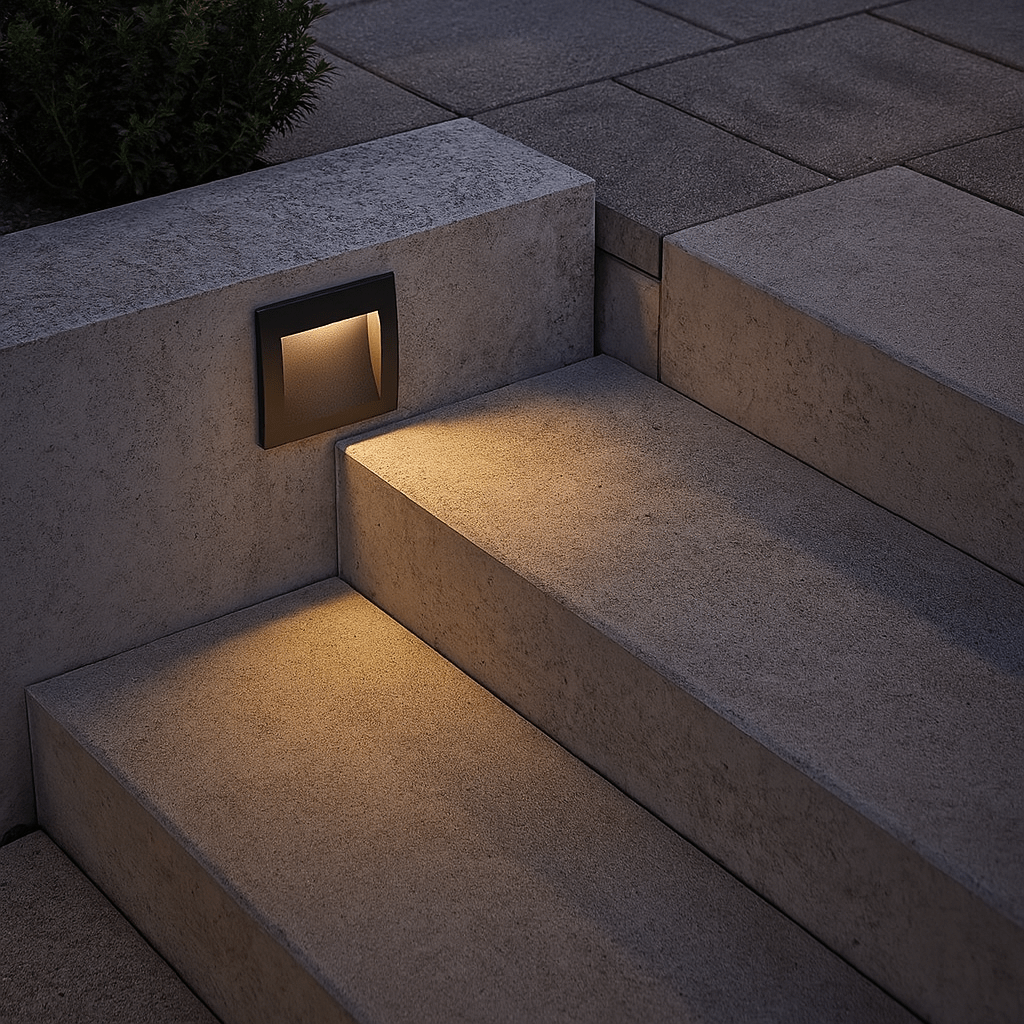
Solar-Powered Step Light Options
Whether you're living off-grid in the Klein Karoo or just trying to reduce energy bills in Joburg suburbia, solar ambient step lights offer flexibility and independence. Like geysers powered by the sun, these luminaires tap into solar gain, especially beneficial in areas prone to load shedding.
At a lodge near Harrismith, we added solar step lights along a decked pathway linking rooms. Their performance exceeded expectations thanks to high-efficiency monocrystalline panels and motion activation. They also linked the system to battery backups for cloudy days. For detailed sunlight maps, see SA Weather Service.
Look for models with 6–10 hour lighting duration and automatic dusk detection. Stainless steel finishes resist corrosion, while IP67 waterproofing ensures longevity. Installation is often as simple as fixing with screws and angling the solar panel correctly—just ensure 4–6 hours of direct sunlight daily.
Micro Summary: Solar-powered step lights are sustainable, low-maintenance, and perfect for both urban homes and rural retreats.

Installation choices vary based on budget and lifestyle—but every option leads to safer steps and richer style.
Quick Checklist
- Choose warm or neutral CCT based on interior mood
- Ensure light fixture IP rating suits indoor or outdoor use
- Position lights at consistent spacing for uniform glow
- Use motion sensors or smart timers for automation
- Match finishes to interior style for cohesion
Check out our full stairway lighting collection, browse our hero strip light solution, or read our related lighting blog for more ideas.
Frequently Asked Questions
Q1: What is the ideal colour temperature for step lights?
Warm white (2700K–3000K) is perfect for a cosy, inviting mood, while neutral white (4000K) offers clearer visibility for modern designs without being too harsh.
Q2: Are step lights safe to install on outdoor stairs?
Yes, provided they have a waterproof IP rating of at least IP65 and are made of UV- and corrosion-resistant materials.
Q3: Can I retrofit step lights into an existing staircase?
Absolutely. Surface-mounted or battery-operated models are perfect for retrofitting without major renovation.
Q4: How far apart should I space my step lights?
A good rule of thumb is one light per step or every 30–40cm to ensure even illumination without dark zones.
Q5: Do step lights use a lot of electricity?
No—most LED step lights consume 1W–3W and last over 25,000 hours, making them extremely energy efficient.
Q6: Can I connect step lights to a motion sensor?
Yes, many LED step lights are compatible with motion sensors or smart controllers to automate lighting when movement is detected.
Q7: Will these lights still work during load shedding?
Yes, solar-powered or rechargeable units provide off-grid functionality ideal for South African homes facing regular outages.
Q8: Are step lights suitable for coastal environments?
Yes, just choose step lights with anti-corrosion finishes like stainless steel or polycarbonate, rated IP65 or higher.


