



Summer days melting into braais at sundown, a cold drink in hand and the warm scent of the garden hitting the breeze — it’s what we live for in South Africa. But if you’ve ever sweltered under a stoep without a whisper of air or left your outdoor lights draining the grid, you’ll know comfort and efficiency don’t always go hand in hand. That’s where a well-chosen energy-efficient outdoor ceiling fan makes all the difference.
Here at Future Light, we once helped a couple in Stellenbosch turn their constantly sweating patio into the coolest spot on their property — literally and figuratively — with a solar-powered ceiling fan and low-wattage ambient LED lighting. It went from sauna to sanctuary overnight. If you’ve got an outdoor area that deserves a breeze and glow, read on.
Key Takeaways
- Energy-efficient outdoor ceiling fans save electricity while keeping your patio cool.
- Look for fan models with LED light kits and solar integration for maximum efficiency.
- Choose high IP-rated fans and fixtures for weather resistance in SA’s diverse climates.
- Coastal regions benefit from corrosion-resistant materials like ABS and marine-grade steel.
- Match your fan’s lighting CCT and CRI to create functional yet comfortable ambiance.
- Pair fans with motion sensors or day/night switches for automation and smarter control.

Choosing the Right Energy-Efficient Outdoor Ceiling Fan
Understanding Power Usage and Efficiency Ratings
In South Africa’s escalating energy landscape, power-saving appliances are no longer nice-to-haves — they’re essentials. Outdoor ceiling fans geared for efficiency typically use DC motors, which outperform traditional AC motors in both wattage and quietness. If you’ve got space in places like Pretoria or Durban, where airflow is key, look for fans under 50W that still move serious air, rated by CFM (cubic feet per minute).
One memorable installation we did involved upgrading an outdated veranda fan in East London with a high-efficiency DC model featuring LED lighting and solar assist. The switch cut the client’s evening energy use in half. For more energy-saving tools, see our range of battery backup solutions. You can also review real-world energy comparison guides on Eskom’s official site.
As a rule of thumb, opt for fans rated with an IP44 or higher for outdoor use, and lighting kits offering LEDs with 3000–4000K CCT for a warm-white ambience. CRI of 80+ ensures your space stays inviting after dark.
Micro Summary: Efficient DC ceiling fans below 50W with LED kits offer airflow and lighting without draining your meter box.

Weather Resistance and Coastal Durability
From Cape Town’s salty winds to the summer storms of Mbombela, outdoor fans are exposed to it all. For coastal applications, go for models made with non-corrosive ABS plastic, marine-grade stainless steel, or powder-coated aluminium. The IP rating should hit at least IP65 for areas where direct spray or moisture might reach the motor or light fitting.
We once supplied a lodge near Ballito with fans that had rusted within 8 months. Replacing them with IP66 ABS fans salvaged not just ambience but reputation. These weather-immune fixtures paired perfectly with our coastal-grade outdoor lighting range and stood up to both wind and weather. Here’s a deep dive into coastal lighting challenges in SA.
Outdoor fans combining corrosion resistance with LED lights (CRI 80+, sealed with silicone gaskets) maintain both airflow and light form in all weather, all year.
Micro Summary: Weather-rated fans with ABS/plastic components and IP65+ design stave off SA’s moist coastal elements.
Smart Integration: Solar, Sensors, and Automation
Imagine stepping onto your balcony in Bloem as your ceiling fan and soft amber LED automatically power on — no switch, no hassle. Smart outdoor fans now bring built-in light sensors, motion control, and solar capability. Especially relevant in load-shedding zones, solar integration can keep airflow uninterrupted (like those in our solar fan range).
We often recommend syncing fans with day/night switches or motion sensors to homes in power-strapped areas. These upgrades—simple to integrate—help ensure energy only flows when needed. See our guide on automation for your outdoor space in Bloemfontein.
Pairing smart automation with efficient LED lighting (ideally 8W or below, 3000K-4000K CCT) creates synergy. These setups not only cut bills but boost your home's resale, especially in tech-savvy markets like Sandton and Stellenbosch.
Micro Summary: Integrate sensors, timers, and solar kits for an automated, low-consumption outdoor airflow solution.
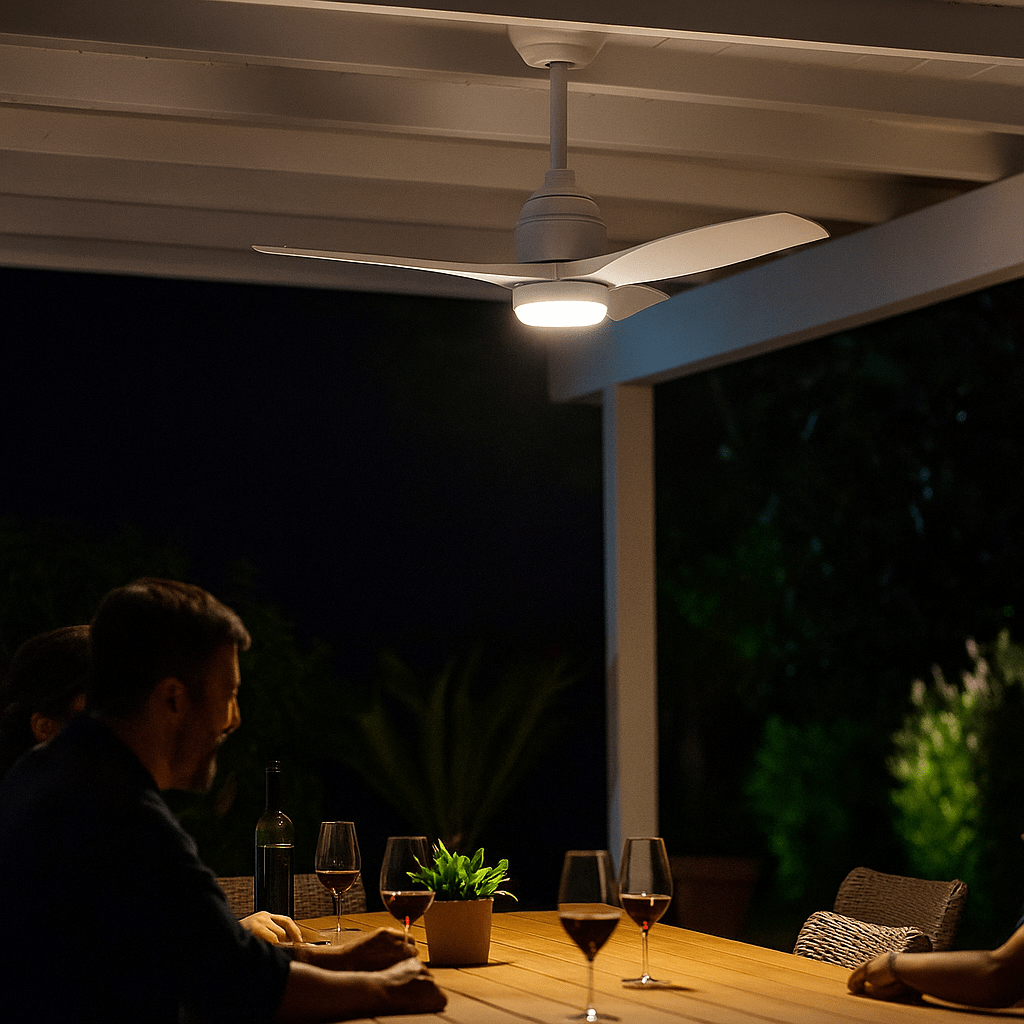
If your outdoor space is your second lounge, a proper fan and lighting combo turns it from an afterthought into the heart of your home year-round.
Optimising Airflow and Lighting Ambience Outdoors
Combining Light Levels with Air Circulation
An outdoor ceiling fan is more than a breeze — it can subtly enhance mood if partnered with purpose-driven lighting. Use warm-white LED kits (2700–3000K) for relaxed ambience under stoeps, or neutral whites (4000K) for functional illumination over an outdoor dining setting like you’ll find in Paarl wine estate lodges.
We fitted a Summerstrand home with a dimmable LED light kit built into their ceiling fan. Bright enough for board games by the braai, yet romantic when dimmed — they couldn’t believe the difference. You can find similar kits among our fan and light combos. See this resource on outdoor LED lighting strategies.
A good ceiling fan light typically outputs 800–1000 lumens at 8-12 watts, with wide beam angles (90–120°) to avoid spotlighting. CRI of 85+ ensures evening colour integrity in social spaces.
Micro Summary: Combine mid-range LEDs and effective fan placement to optimise airflow and outdoor mood lighting.

Ceiling Fan Positioning and Coverage Areas
Placement is as critical as the product itself. Fans should sit 2.4–2.7m off the ground, with blades ideally 60cm from walls or beams. On wide patios, multiple fans evenly spaced work better than a single oversized one fighting physics. For SA homes in Pretoria with long verandas, dual IP65 fans provide even airflow end-to-end.
One customer in Port Elizabeth complained of a breeze “going crooked” — turns out their fan blades were curved the wrong way for local building orientation. We make a point to match airflow direction to real-world patio placement, especially with products like those in our solar fan collection and outdoor patio lighting.
Use fans between 122–132cm for areas under 25 sqm. Bigger spaces (like farm lapa settings) may require commercial-grade 144cm+ fans with at least 6000+ CFM airflow ratings.
Micro Summary: Correct fan sizing and blade clearance ensure comfort, direction, and full-coverage airflow outdoors.

Balancing Design with Function
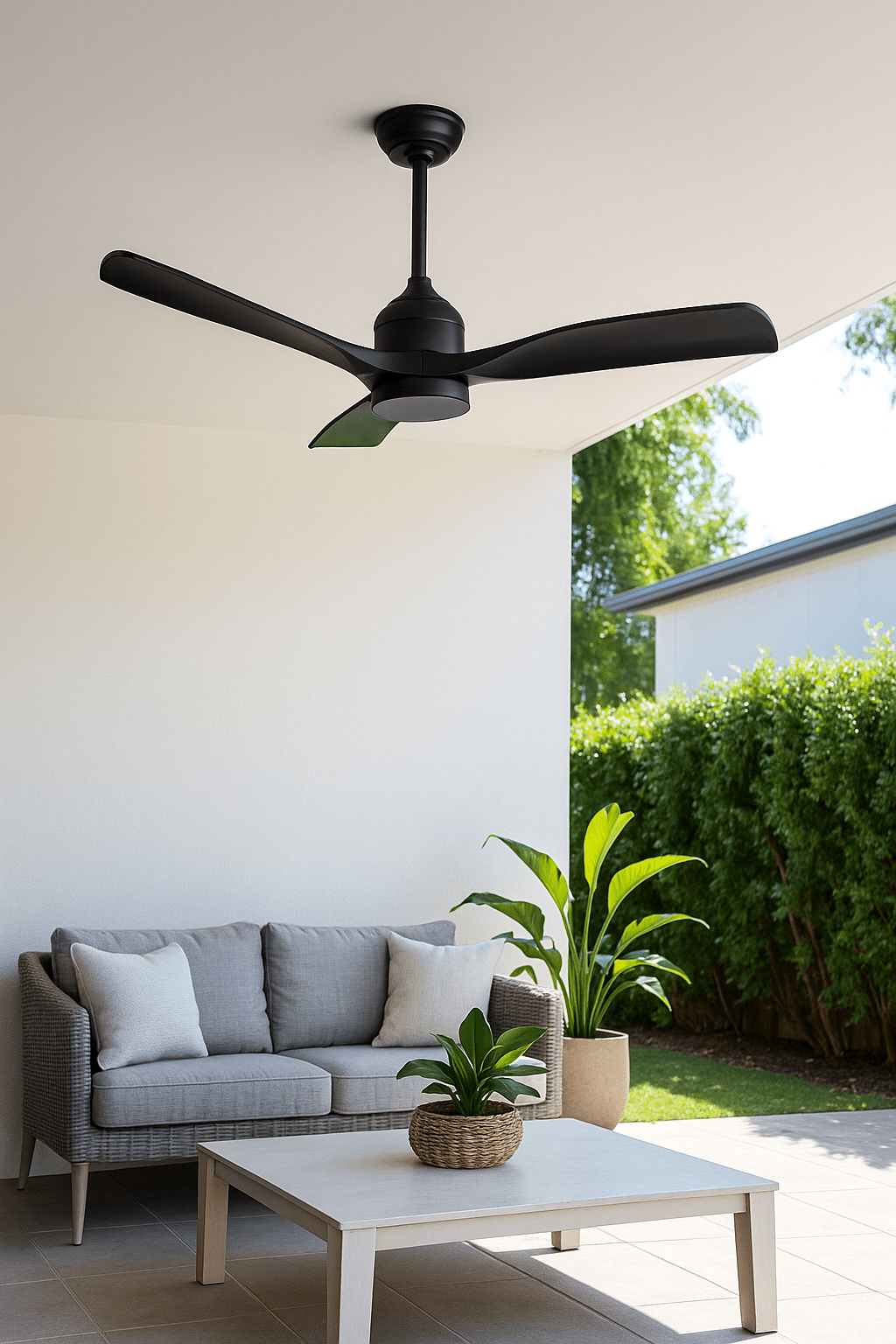
From modern chrome finishes to rustic timber-like ABS blades, South Africans are marrying form with function more than ever. Ceiling fans now need to complement your outdoor aesthetic as much as they cool the space. Match black fans with monochrome outdoor seating, or go warm bronze for coastal homes in Hermanus.
A luxury Knysna home recently sourced a matte black fan from our designer lighting collection to match a rattan pendant from our rattan range. The blend of texture, tone, and tech gave the home visual balance without compromise. Here’s a great article on matching outdoor lighting with mood.
Choose subtle 3000–4000K LEDs for soft contrast and avoid downlights directly over blades—they can cause dizzying flicker patterns. Stick with side-mount lighting or diffuse-glow integrated kits.
Micro Summary: Coordinating your fan’s aesthetic with light style gives you both airflow comfort and visual continuity outside.

Your outdoor fan setup should work like a great backup singer — functional, supportive, and stylish without stealing the spotlight.
Quick Checklist
- Look for outdoor-rated DC motor ceiling fans under 50W power draw.
- Choose IP65 minimum for weather resistance, especially in coastal areas.
- Pick LED light kits with 3000K-4000K CCT and CRI 80+ for comfy ambience.
- Integrate motion sensors or solar options for efficiency and automation.
- Match fan style and blade finish to your outdoor décor for cohesive design.
Need help picking the perfect fan for your patio, veranda, or balcony? Explore our ceiling fan collection, browse our latest fan-integrated lighting, or check out our guide to automating your outdoor lights.
Frequently Asked Questions
Q1: Are all ceiling fans suitable for outdoor use?
No, only ceiling fans with specific weatherproof ratings like IP44 or higher and materials resistant to moisture and corrosion (e.g., ABS plastic or stainless steel) are suitable for outdoor mounting.
Q2: Can I use solar power to run an outdoor ceiling fan in South Africa?
Yes, several ceiling fans support solar integration or can be connected to solar inverters and backup battery systems common in SA homes facing load-shedding.
Q3: How much energy can I save using an energy-efficient fan instead of air conditioning?
On average, energy-efficient ceiling fans use 90% less electricity than standard aircon units, leading to significant savings during summer months.
Q4: What is the ideal size fan for a 20 square metre patio?
A fan with a 122–132cm blade span is best for 20sqm areas, providing optimal airflow without overpowering the space visually or acoustically.
Q5: Are LED lights included in ceiling fans dimmable?
Many modern fan-integrated LEDs are dimmable, though you'll need compatible dimmer switches or remote controls to adjust them smoothly.
Q6: What IP rating should I look for in humid coastal regions?
At least IP65 or higher is recommended for fans in coastal regions like Durban or East London to protect against salt-air corrosion and rain exposure.
Q7: How noisy are energy-efficient fans?
Fans with DC motors are extremely quiet, making them perfect for outdoor relaxation, children’s areas and peaceful evenings under the stoep.
Q8: Can I install an outdoor ceiling fan myself?
While possible, it’s advisable to use a certified installer, especially for outdoor applications where moisture requires careful insulation and IP-rated fittings.


