



Modern Pendant Lights for Transforming South African Dining Spaces
In South African homes, the dining table isn’t just for supper – it’s homework central, braai overflow seating and where big family decisions get made. The right light above that table can quietly transform all of those moments.
Over the years at Future Light, we’ve helped everyone from Joburg apartment owners to coastal family homes in Gqeberha turn dull dining corners into warm, modern gathering spots simply by rethinking their pendant lighting. When a Cape Town client recently swapped a tired single fitting for a row of elegant LED pendants, her exact words were: “It feels like we renovated – but we only changed the lights.”
This guide unpacks how modern pendant lights can do exactly that for your dining area – with practical, South African-specific advice you can use today.
Key Takeaways
- Choose pendants that suit the shape and size of your dining table to avoid glare, dark spots or visual clutter.
- For dining areas, aim for 2,000–4,000 lumens over the table with 2700–3000K warm white and CRI 80+ for flattering skin tones and food.
- Mount pendants 70–85cm above the table and space multiple fittings 60–80cm apart for balanced light and clear sightlines.
- Use style, material and colour to either contrast or complement your décor – glass, rattan and metal pendants each create a different mood.
- Consider coastal air, dust and humidity when choosing finishes and IP ratings, especially for open-plan dining rooms near patios.
- Always check dimmability, bulb type and quality of components to cope with load-shedding, future upgrades and long-term reliability.
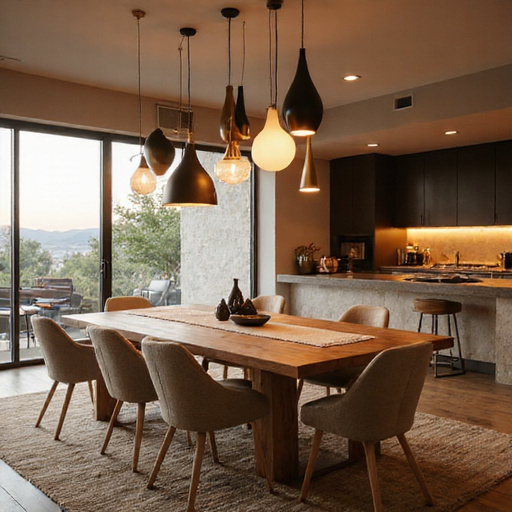
How Do Modern Pendant Lights Change the Feel of a Dining Room?
What makes pendant lights so powerful for South African dining spaces?
Pendants work so well above a dining table because they bring the light closer to the action, creating a focused pool of warmth that instantly feels intimate and welcoming.
Unlike general ceiling fittings that just wash the whole room, modern dining pendants visually “anchor” the table – whether it’s a sleek black design in a Sandton apartment or woven rattan over a farmhouse table in Stellenbosch. That focal point naturally draws people in and makes gatherings feel special, even on a Tuesday night with reheated curry.
From a technical side, bringing the light source closer means you can achieve comfortable brightness (150–250 lux at table height) using lower wattage LED lamps – often just 6–12W per pendant, especially when you use efficient LED bulbs with 80+ lumens per watt.
In short: A good pendant centres the room around the table, adds intimacy, and delivers efficient, comfortable light exactly where you need it most.

How do modern pendants improve both everyday use and special occasions?
The right pendants let you move smoothly from bright, practical light for homework and admin to soft, atmospheric light for dinner parties and late-night chats.
We see this daily with clients using dimmable LED pendants in open-plan homes from Pretoria to Ballito. Paired with dimmable drivers and quality dimmable LED bulbs, they can crank things up to 400 lux for puzzles and projects, then glide down to 100–150 lux for candlelit vibes without changing fittings.
Technically, a 2700–3000K warm white pendant combined with a dimmer offers the broadest range of moods. At full power, CRI 80–90+ ensures food colours look true and appetising, while at lower levels the same colour temperature becomes cosy and intimate rather than cold or clinical.
Bottom line: Modern pendants give you flexible, layered light that works for school projects, Zoom calls and anniversary dinners in one simple layout.

How important is colour temperature and CRI in dining room pendants?
For dining spaces, a warm colour temperature with good colour rendering is crucial because it flatters skin tones, makes food look appealing and keeps the room feeling relaxed.
In South African homes we typically recommend 2700K for a very cosy feel or 3000K for a slightly crisper but still warm look, especially in modern open-plan areas where you might mix with cooler kitchen lighting. CRI (Colour Rendering Index) of at least 80 is a non-negotiable baseline; for feature dining spaces, CRI 90+ really makes wood grains, fabrics and food colours pop.
To put it in numbers: a cheap 70 CRI bulb can distort reds and warm tones by 20–30%, while a CRI 90 bulb keeps colour differences under 10%, according to general CRI standards. That’s the difference between “grey-ish” steak and beautifully rich, appetising colour under your pendant light.
Key takeaway: Aim for 2700–3000K and CRI 80–90+ so your dining room feels warm and your meals and guests look their best.

When pendants are chosen with the right optics, colour temperature and CRI, they don’t just light up a table – they completely shift how the room feels and functions.
How Do You Choose the Right Modern Pendant for Your Dining Table?
What size and shape pendant suits my dining table best?
Match pendant size and layout to your table shape so the light spreads evenly without overpowering the room or leaving dark corners.
For a 6–8 seater rectangular table (around 1.8–2.4m long), a row of three smaller pendants or a linear bar pendant works brilliantly. Round tables, common in compact Cape Town apartments, usually suit a single medium-to-large feature pendant hung centrally. Our dedicated guide to pendant height and placement in South African homes goes deeper into this with diagrams and examples.
A useful rule-of-thumb: the combined pendant width over a rectangular table should be roughly 60–70% of the table length. For example, over a 2m table, aim for around 1.2–1.4m of total pendant spread (three 35–40cm pendants or a 1.2m linear fitting).
In short: Let your table shape and size dictate your pendant style and spread, aiming for 60–70% coverage of the table length or diameter.

How bright should my dining pendants be (in lumens and watts)?
A dining table typically needs 2,000–4,000 lumens of focused light, depending on table size, room colour and whether you have dimming or additional ambient lighting.
As a starting point for South African homes, many clients land up with three 6–10W LED pendants over a 6–8 seater, each delivering around 600–800 lumens. That gives you roughly 1,800–2,400 lumens over the table, which feels comfortable if you also have downlights or wall lights for background light. Where walls are dark or ceilings high (2.8m+), nudging closer to 3,000 lumens total usually feels better.
It’s worth remembering that modern LEDs often give 85–100 lumens per watt, compared to older incandescent lamps that delivered around 10–15 lumens per watt. So a 7W LED filament bulb can easily replace a 60W incandescent over your dining table while using about 88% less power.
Bottom line: Aim for a total of 2,000–4,000 lumens over your dining table and use efficient 6–12W LED bulbs per pendant to get there without wasting energy.

What materials and styles of modern pendants work best in SA homes?
Choose pendant materials that suit your décor, climate and cleaning tolerance so your lights stay beautiful and practical for years.
In South Africa we see three big style families above dining tables: clean-lined glass pendants for contemporary homes, rattan or woven pendants for coastal and boho spaces, and matte metal or black finishes for industrial or minimalist looks. Our curated dining room lighting collection mixes all three so you can match your table and chairs easily.
From a technical and local perspective, glass can show dust but handles humidity well in coastal regions; rattan softens the light and hides fingerprints but should be kept away from direct kitchen grease; powder-coated metal is robust and easy to wipe, but be cautious with cheap chrome near salty air – coastal-grade finishes or indoor placement are safer.
Key takeaway: Pick a pendant style that suits both your décor and your environment, with finishes that can handle South African dust, humid summers and day-to-day life.

When size, brightness and style all line up with your table and décor, your pendants stop feeling like “lights” and start feeling like part of the furniture.
How High Should You Hang Modern Dining Pendants in South Africa?
What is the ideal height for pendants above a dining table?
Most dining pendants look and perform best when the bottom of the shade is 70–85cm above the tabletop, balancing glare control with a strong visual presence.
In a typical South African home with 2.4–2.7m ceilings, this height keeps the light source out of your direct line of sight but low enough to define the dining zone, especially in open-plan rooms. For taller family members or very deep shades, lean towards 80–85cm; in smaller apartments, you can come down to 70cm to avoid making the fitting feel detached from the table.
Measured another way, that usually puts the pendant base around 1.75–1.9m above the floor if your table is the standard 75cm high. According to most international lighting layout guides, this is firmly in the recommended residential dining height range and aligns well with SANS 10114 lighting comfort principles around glare and viewing angles.
In short: Hang your dining pendants roughly 70–85cm above the table surface so they feel connected to the table but never block your view across it.

How do you space multiple pendants over a long dining table?
Space pendants evenly along the table length, usually 60–80cm apart, while keeping at least 30–40cm from each table end to avoid crowded or dark edges.
For example, over a 2.1m table, three pendants centered and spaced around 70cm apart, with roughly 35–40cm breathing room at each end, often looks spot on. In larger Pretoria or Durban open-plan homes with 2.4–3m tables, four smaller pendants can work if you keep them evenly distributed and aligned with the table edges for a clean architectural look.
From a performance point of view, overlapping beam angles are key. If your pendants have 60–90° beam angles and are 75cm above the table, 60–80cm spacing usually ensures their light circles overlap nicely, preventing patchy bright and dark spots across plates and board games.
Bottom line: Even spacing of 60–80cm with a little breathing room at the table ends gives you both visual rhythm and smooth, overlapping light.

What about open-plan dining areas next to kitchens or patios?
In open-plan spaces, hang dining pendants slightly lower than kitchen lights and use warmer colour temperatures so the table area feels distinct yet still integrated.
We see this a lot in Joburg and Cape Town where island pendants might sit at around 85–90cm above the counter in 3000–3500K, while dining pendants drop slightly lower at 70–80cm above the table in 2700–3000K. If your dining space flows onto a covered patio, consider IP20 pendants indoors and weather-resistant outdoor lighting outside to handle wind-driven rain and humid coastal evenings.
Technically, interior pendants can sit at IP20–IP22 in protected rooms, but if your dining area is right next to sliding doors in a windy coastal town, stepping up to IP44 or using corrosion-resistant finishes can massively extend the life of your fittings.
Key takeaway: Use height, colour temperature and IP rating to subtly separate dining, kitchen and patio zones without breaking the open-plan flow.

Getting height and spacing right is one of those small details that instantly makes your home look “designer”, even if everything else is simple and minimal.
Modern Pendant Styles Compared for South African Dining Rooms
Should I choose clear glass, frosted glass, metal or rattan pendants?
Pick your pendant material based on the mood you want, how much glare control you need and how much cleaning you’re willing to do.
Clear glass pendants like the Jasmine or Fifty50 styles are amazing for modern spaces because they echo natural light and show off filament bulbs, but they can create more sparkle and potential glare if hung too high. Frosted or opal glass diffuses the light softly – ideal for families in Gauteng or KZN who want super-comfortable light for long dinners. Rattan brings that relaxed, holiday-at-home feeling, while solid metal shades focus light downwards and keep the room edge darker and moody.
In real projects, we often see Jozi urban apartments going for clear or smoked glass from collections like glass pendants, while coastal homes in places like Ballito love rattan for its softness and resilience. For anyone sensitive to light, frosted glass or fabric diffusers plus 2700–3000K bulbs give the gentlest result.
In short: Choose clear glass for sparkle, frosted glass for softness, rattan for warmth and metal for focused, dramatic pools of light.

| Feature | Clear / Opal Glass Pendant | Metal / Rattan Pendant |
|---|---|---|
| Glare control | Clear = higher sparkle, opal = softer | Metal = strong cut-off, rattan = gentle patterns |
| Cleaning & maintenance | Shows fingerprints and dust more | Metal easy to wipe, rattan hides dust |
| Light spread | More ambient fill and reflections | More downward focus on table |
| Best use case | Modern and minimalist SA dining rooms | Cosy, coastal, rustic or industrial spaces |
Do I need dimmable modern pendants in my dining room?
Dimmable pendants aren’t essential, but they dramatically increase flexibility, comfort and perceived “luxury” in a dining space for a relatively small extra cost.
We’ve had countless Future Light customers phone us back after installing dimmable pendants saying it’s the single feature they now wouldn’t live without. In South African households, where the dining table often doubles as a home office or homework station, the ability to hit 100% output for concentration and then drop to 30% for a braai-night dessert is priceless.
From a technical angle, make sure both the driver/fitting and the bulb are LED-dimmable, and match them with a compatible LED dimmer. Good LED dimming should give you stable light from at least 10–15% to 100% with no flicker, which also helps avoid eye strain during long evenings.
Bottom line: While not mandatory, dimmable pendants are one of the best-value upgrades you can make to a modern dining room.

How does Future Light help South Africans get pendant lighting right?
Future Light has spent well over a decade helping South Africans choose and install modern pendant lights that work beautifully with local homes, ceilings, wiring and lifestyles.
From specifying full dining-lounge schemes for new builds in Centurion to helping a Durban couple choose a single statement chandelier from our chandeliers range, we’ve seen almost every room shape and ceiling height you can imagine. That experience filters into our product selection, where we prioritise quality drivers, sensible lumen outputs and finishes that stand up to South African conditions.
Because we also stock complementary lighting like indoor wall lights and LED downlights, we’re able to help you layer your dining light properly – pendants as the heroes, with supporting cast members that don’t fight for attention.
Key takeaway: You’re not picking pendants in isolation – you’re tapping into years of South African-specific lighting know‑how and a full ecosystem of compatible products.

When you bring experience, good products and a bit of planning together, your dining pendants can quietly become one of your favourite “features” in the whole house.
Quick Checklist
- Confirm how you actually use the dining table (meals only, or also homework, puzzles, remote work) to set your brightness and dimming needs.
- Choose a colour temperature around 2700–3000K for warm, welcoming light that still works for reading and board games.
- Look for CRI 80+ minimum, and ideally CRI 90+ if you care about how food, art and timber surfaces appear.
- Check IP and material suitability if your dining area is coastal or semi-outdoor, and prioritise corrosion-resistant finishes where needed.
- Plan installation to SANS-compliant standards, with safe mounting, correct cabling, and compatible dimmers and bulbs.
When you’re ready to transform your dining room with modern pendants that are actually built for South African homes, explore our curated pendant lighting collection, pick a favourite hero piece for your dining table, and dive deeper into layering your home lighting with our ultimate indoor lighting guide.
Frequently Asked Questions
Q1: How high should modern pendant lights hang above a dining table?
Pendant bases should sit about 70–85cm above the dining table so the lights feel connected to the table but don’t block views or cause uncomfortable glare.
Q2: What colour temperature is best for dining room pendant lights?
Warm white between 2700K and 3000K works best over dining tables because it flatters skin tones, keeps food looking appetising and creates a relaxed, welcoming atmosphere.
Q3: How bright should my dining room pendants be?
Aim for around 2,000–4,000 lumens in total over the dining table, typically achieved with two to four LED pendants using 6–12W LED bulbs each, depending on table size.
Q4: Are dimmable modern pendants worth it in South African homes?
Dimmable pendants are highly worthwhile because they let you switch from bright task lighting to soft, intimate light, which suits multi-use South African dining tables perfectly.
Q5: Can I use LED filament bulbs in modern glass pendants?
Yes, LED filament bulbs work brilliantly in clear or smoked glass pendants, giving that classic filament look while using around 80–90% less energy than old incandescent bulbs.
Q6: How many pendants should I use over a 2m dining table?
For a 2m rectangular table, three evenly spaced medium pendants or one substantial linear pendant usually provides nicely balanced light and good visual proportion.
Q7: Are IP44 or higher-rated pendants necessary for indoor dining areas?
Standard indoor dining rooms are fine with IP20 fittings, but IP44 or better is recommended for semi-outdoor spaces or rooms exposed to sea air and wind-blown moisture.
Q8: Can modern pendant lights replace all other dining room lighting?
Pendants can be the main feature light, but pairing them with downlights or wall lights gives better overall brightness control, flexibility and a more premium layered lighting effect.


